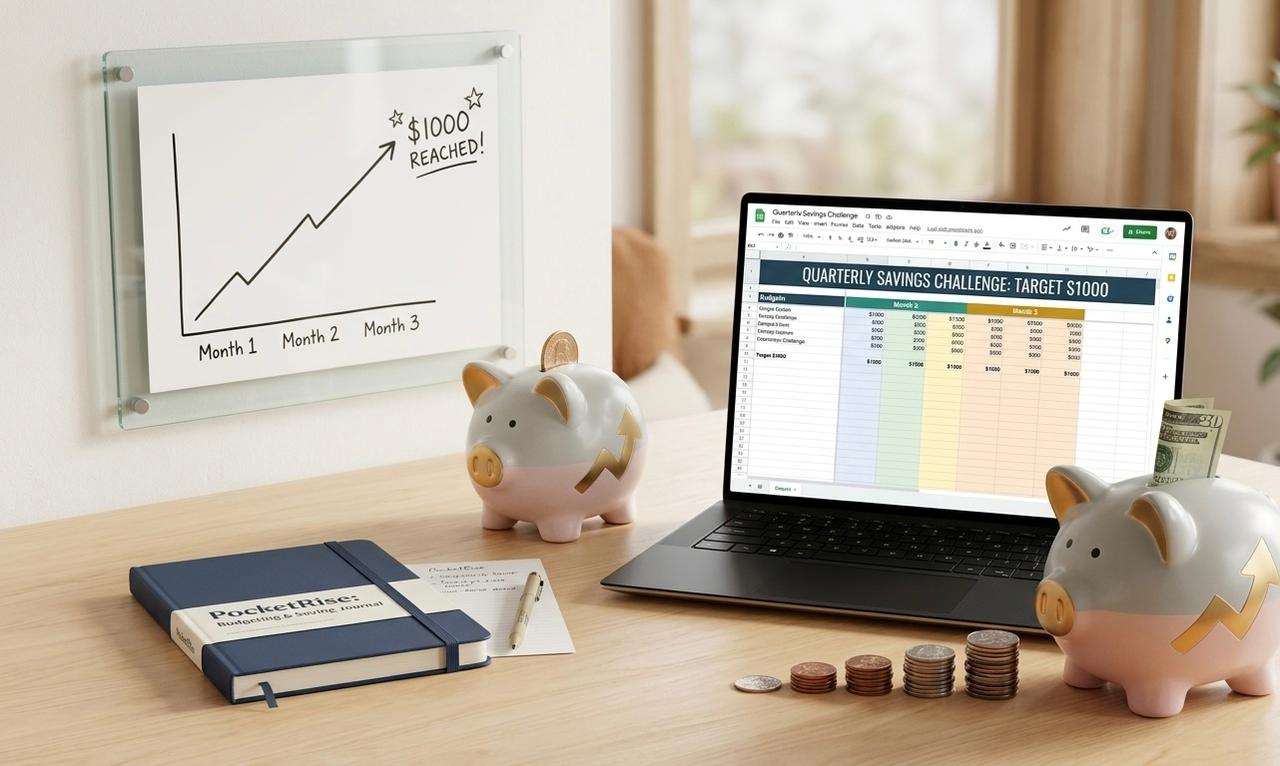
How to Save $1000 in 3 Months on a Low Income


Published on POCKETRISE | May 16, 2026


Let’s be honest — saving money when you’re living paycheck to paycheck feels almost
impossible. You look at your bank account after paying bills and groceries, and there’s
barely anything left. So when someone says, “Just save $1000 in three months!”
it can feel like a cruel joke.


But here’s the truth: saving $1000 in 90 days on a low income is possible —
and thousands of people are doing it right now. You don’t need a six-figure salary or
a budgeting degree. You just need a clear plan, a little discipline, and the right
strategies working in your favor.


Think about it this way. $1000 in 3 months breaks down to roughly $334 per month,
or about $11 per day. That reframe alone makes it feel a lot more
achievable, doesn’t it? Let’s walk through exactly how to make it happen — starting today.


5 Practical Tips to Save $1000 in 3 Months


Tip 1: Track Every Dollar You Spend (Yes, Every Single One)


Before you can save money, you need to know where your money is actually going. Most
people are genuinely surprised when they start tracking their spending. That daily
coffee run, the random Amazon purchase, the subscriptions you forgot you signed up
for — it all adds up fast.


Real Example: Sarah, a retail worker earning $1,800/month, started
tracking her expenses using a free app called Mint. Within one week, she discovered
she was spending $140/month on food delivery apps without realizing it. By cooking
at home just four extra times per week, she freed up over $100 immediately.


Use a free budgeting app like Mint, YNAB (free trial), or even a simple
Google Spreadsheet
to log every expense. Do this for the first two weeks and
watch the patterns emerge.


Tip 2: Cut One “Invisible” Expense Right Now


Invisible expenses are the sneaky subscriptions and habits that quietly drain your
account every month. Streaming services, gym memberships you don’t use, premium app
upgrades — these are your first targets.


Real Example: Marcus was paying for Netflix, Hulu, Disney+, AND
Spotify — totaling $62/month. He paused Disney+ and Hulu (you can always re-subscribe
later!) and saved $22/month. That’s $66 saved over three months just from that one
decision.


Go through your bank statement right now and cancel or pause at least one
subscription
you haven’t used in the last 30 days. Small cuts create big
momentum.


Tip 3: Set Up an Automatic “

- Pocketrise


How to Save $1000 in 3 Months on a Low Income | POCKETRISE


How to Save $1000 in 3 Months on a Low Income


Published on POCKETRISE | May 16, 2026


Let’s be honest — saving money when you’re living paycheck to paycheck feels almost
impossible. You look at your bank account after paying bills and groceries, and there’s
barely anything left. So when someone says, “Just save $1000 in three months!”
it can feel like a cruel joke.


But here’s the truth: saving $1000 in 90 days on a low income is possible —
and thousands of people are doing it right now. You don’t need a six-figure salary or
a budgeting degree. You just need a clear plan, a little discipline, and the right
strategies working in your favor.


Think about it this way. $1000 in 3 months breaks down to roughly $334 per month,
or about $11 per day. That reframe alone makes it feel a lot more
achievable, doesn’t it? Let’s walk through exactly how to make it happen — starting today.


5 Practical Tips to Save $1000 in 3 Months


Tip 1: Track Every Dollar You Spend (Yes, Every Single One)


Before you can save money, you need to know where your money is actually going. Most
people are genuinely surprised when they start tracking their spending. That daily
coffee run, the random Amazon purchase, the subscriptions you forgot you signed up
for — it all adds up fast.


Real Example: Sarah, a retail worker earning $1,800/month, started
tracking her expenses using a free app called Mint. Within one week, she discovered
she was spending $140/month on food delivery apps without realizing it. By cooking
at home just four extra times per week, she freed up over $100 immediately.


Use a free budgeting app like Mint, YNAB (free trial), or even a simple
Google Spreadsheet
to log every expense. Do this for the first two weeks and
watch the patterns emerge.


Tip 2: Cut One “Invisible” Expense Right Now


Invisible expenses are the sneaky subscriptions and habits that quietly drain your
account every month. Streaming services, gym memberships you don’t use, premium app
upgrades — these are your first targets.


Real Example: Marcus was paying for Netflix, Hulu, Disney+, AND
Spotify — totaling $62/month. He paused Disney+ and Hulu (you can always re-subscribe
later!) and saved $22/month. That’s $66 saved over three months just from that one
decision.


Go through your bank statement right now and cancel or pause at least one
subscription
you haven’t used in the last 30 days. Small cuts create big
momentum.


Tip 3: Set Up an Automatic “

“`html


How to Save $1000 in 3 Months on a Low Income | POCKETRISE

How to Save $1000 in 3 Months on a Low Income

Published on POCKETRISE | May 16, 2026

Let’s be honest — saving money when you’re living paycheck to paycheck feels almost
impossible. You look at your bank account after paying bills and groceries, and there’s
barely anything left. So when someone says, “Just save $1000 in three months!”
it can feel like a cruel joke.

But here’s the truth: saving $1000 in 90 days on a low income is possible —
and thousands of people are doing it right now. You don’t need a six-figure salary or
a budgeting degree. You just need a clear plan, a little discipline, and the right
strategies working in your favor.

Think about it this way. $1000 in 3 months breaks down to roughly $334 per month,
or about $11 per day. That reframe alone makes it feel a lot more
achievable, doesn’t it? Let’s walk through exactly how to make it happen — starting today.

5 Practical Tips to Save $1000 in 3 Months

Tip 1: Track Every Dollar You Spend (Yes, Every Single One)

Before you can save money, you need to know where your money is actually going. Most
people are genuinely surprised when they start tracking their spending. That daily
coffee run, the random Amazon purchase, the subscriptions you forgot you signed up
for — it all adds up fast.

Real Example: Sarah, a retail worker earning $1,800/month, started
tracking her expenses using a free app called Mint. Within one week, she discovered
she was spending $140/month on food delivery apps without realizing it. By cooking
at home just four extra times per week, she freed up over $100 immediately.

Use a free budgeting app like Mint, YNAB (free trial), or even a simple
Google Spreadsheet
to log every expense. Do this for the first two weeks and
watch the patterns emerge.

Tip 2: Cut One “Invisible” Expense Right Now

Invisible expenses are the sneaky subscriptions and habits that quietly drain your
account every month. Streaming services, gym memberships you don’t use, premium app
upgrades — these are your first targets.

Real Example: Marcus was paying for Netflix, Hulu, Disney+, AND
Spotify — totaling $62/month. He paused Disney+ and Hulu (you can always re-subscribe
later!) and saved $22/month. That’s $66 saved over three months just from that one
decision.

Go through your bank statement right now and cancel or pause at least one
subscription
you haven’t used in the last 30 days. Small cuts create big
momentum.

Tip 3: Set Up an Automatic “

Leave a Comment

Your email address will not be published. Required fields are marked *